Tuesday, February 1, 2011

Film Review - True Grit


Rough and Ready

By Kevin Wong

Toward the end of “True Grit,” after deliberate delays, we finally get a look at Tom Chaney (Josh Brolin), the low down man who murdered 14-year-old Mattie’s (Hailee Steinfeld) father. He’s muddy, inebriated, and bleary eyed. He speaks with an absent-minded slur. He stumbles with the determination of a wino attempting to walk a straight line. And suddenly, it occurs to me that I am watching a portrayal of a ‘real drunk,’ sans any sort of irony or artistry. He’s not glamorized, Hollywood style, as a wayward rogue for his addictions, nor is his alcoholism used as a vicarious glimpse into his inner, evil devil. He is merely a pathetic, sad, little man, and the first thing that crossed my mind was “what a waste,” of his life and of Mattie’s father’s.

It's an insightful, inspired characterization in a film that is strangely careful. I say strangely, because it is decidedly against type for the Coen brothers to write and direct a film that fits so comfortably into its Western genre. Gone are the sly winks at the camera, the hyperbolized accents, the race-laden dialects, and the comedy of errors that make a Coens film a drama and a farce in equal measures.

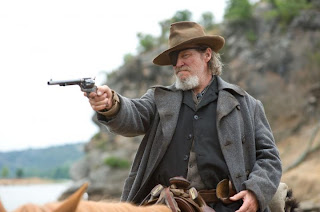
The film is a classic tale of revenge. Mattie Ross is a tough as nails, morally rigid 14-year-old. She seeks justice for the murder of her father, and she hires Rooster Cogburn (Jeff Bridges), the meanest, drunkest U.S. Marshal she can find, to help her bring down Tom Chaney, the man who killed him. Joining this unlikely pair is LaBoeuf (Matt Damon), an ‘in over his head’ Texas Ranger who has been tracking Chaney for quite some time.

As the plot develops, the viewer gains a real sympathy for Mattie. Steinfeld gives a carefully wrought, award-worthy performance; she depicts Mattie as spunky and precocious without making her cloying and manipulative. Mattie is never anyone’s victim, even at her lowest moments. Her ethos is established very early on; she haggles with and threatens a man five times her age with nothing but words, and their 4-minute exchange, filmed in uncomfortable close-up, had me in stitches.
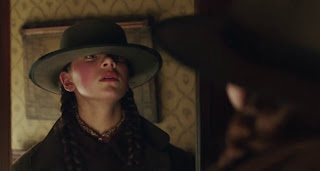
Bridges, Damon, and Brolin, all acting veterans, have the self-confidence and judiciousness to step back and allow Steinfeld to steal the show. Their performances are perfect support. Bridges, similar to Brolin, also plays his alcoholism for its realism rather than its dramatic qualities. Damon disappears into his role, playing his character as an understated, insecure man who talks bigger than he’s capable of.

Technically, “True Grit” is flawless, and it’s one of the better films this year. The acting is solid, the camera work is solid, the editing is solid (though the narrative lags slightly in the middle), and the plot, while stock, is well played. The photography is beautiful, depicting the West as both grimy and gorgeous. Is this enough, however, to make it a ‘great’ film?
In the past, the Coens have dealt with common, retread themes about the American heartland. They experimented, however, with tone to keep their films relevant and fresh. A couple of years ago, I was having a conversation with a friend about “No Country for Old Men” (2006), and he pointed out that thematically, it had a lot in common with “Fargo” (1996); both films dealt with the corrupting influence of ill gotten money, both include portrayals of capable law enforcers over their heads in trouble, and both have an atmosphere of pervasive dread. In “Fargo,” it’s the wide-angle shots of snow, and in “No Country for Old Men,” it’s the wide-angle shots of red dirt that make the viewer think, “Wow. This place is physically and spiritually dead.”

The two films, however, take different approaches to dealing with that sense of rural alienation. “Fargo” plays it for laughs, ramping up the ‘Minnesota nice’ and cloistered naivete of the characters to comedic effect. “No Country for Old Men” wallows in it, using silence for its soundtrack and painting its characters and settings as apocalyptic, complete with the long, black shadows that they cast. Neither approach is more effective than the other; both make these films modern classics in their own right.

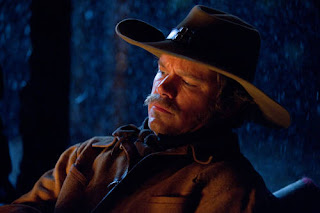
“True Grit” deserves most of the accolades it has been receiving. It is not, however, a modern classic like its predecessors; its comparative lack of eccentricity has a way of holding it back from greatness. There are glimpses of transcendence; Chaney's characterization is unique, and Rooster’s tear jerking, midnight ride to save Mattie’s life takes place underneath an eerie blanket of stars. The epilogue, depressing in its lack of resolution, is appropriate, though thoroughly aggravating. The film’s score is variations on the gospel hymn “Leaning on the Everlasting Arms,” a bold choice that complements the violent, rugged action perfectly.

Ultimately, however, “True Grit” does not add something new to the Western genre. The viewer never sees the characters’ quirks and eccentricities, for better or for worse; the film is overly earnest and forthright in its motives, and the characters are a little too safe and a little too static. Some critics have lauded this simpler, back-to-basics approach, which is a throwback to Old Hollywood storytelling, but I disagree. It’s 2011, and the tropes of the West have been overly established. The Coens have made a ‘perfect Western,’ but ironically (and contextually), this is the very thing that also makes it flawed.


Rating: 7.5
To see my ratings system, click here

Thursday, January 27, 2011

White Supremacists Annoy Me

Read the following link from the Wall Street Journal: "Why Chinese Mothers are Superior." It will give you the appropriate context:

When I read this article, the first thing I thought was that the mother is emotionally abusive; I don't personally know anyone who has been raised in such a limited manner (although she might be hyperbolizing for the sake of publicity).

I forgot all about the article until a friend from college emailed me the article, and one of his friends mass replied with the following bizarre, xenophobic response:

From: [Name redacted]
Sent: Wed, January 26, 2011 4:53:23 PM
Subject: Re: Why Chinese mothers are superior

Whilst I appreciate any discussion that emphasises differences across cultures, this article does little to explain the general success of the Chinese. The Chinese are generally successful because they are generally very intelligent. This woman's horrible model for rearing children might have worked in making rigid piano players or straight A-students, but has little or nothing to do with actual success in life. The prohibition from watching television or playing video games is good, as are some of her other ideas. But in the end, she gives herself far too much credit for her children's intellectual capacity. Finally, she makes the great blunder of assuming that good ways to raise Orientals will also work with Westerners.

Let the Chinese show one tenth of the ingenuity of the West and then I'll listen to her diatribes about not allowing her children to make decisions of their own. Yes, the Chinese produce kids who can solve Rubik's cubes in thirty seconds, score high on standardised tests, and play Bach inventions at perfect speed (and zero style) - the perfect results of forced learning by rote. No, in the West we do not pat ourselves on the back for such useless achievements.
Thomas Edison, Leonard Euler, Wolfgang Mozart, Thomas Aquinas, and the Wright Brothers - these are the jewels of the West upon whose backs the entirety of China will be indebted forever. No, the Wright Brothers probably could not play the piano very well. But they had the insatiable drive to tinker and explore until they got to the bottom of the answer - something that was allowed to them in their youth by their father, Bishop Martin Wright.

Good for you, Chinese mother. You go, girlfriend. As for me, I'll raise my children as Vikings - always curious as to what lays beyond and never willing to stick to what is known. You can go right ahead and spend all your time forcing your children (who are being raised in a European country) to play European compositions on European instruments and perform in European plays at the local public school. And using European-invented lighting the whole way, of course.

There may have been a time in my life where I would have responded to him with aggressive, angry invective. Instead, I decided to mass reply to him and all his friends with the following:

Wed, January 26, 2011 5:37:22 PM
Re: Why Chinese mothers are superior
I'm afraid that you're making the mistake of assuming that the Chinese are generally very intelligent. As a teacher in a culturally diverse area, the ratio of dumb to smart across cultures is pretty consistent; a few losers, a few winners, and a lot of C students in the middle. Unfortunately, the Chinese are stereotyped from the out start by unrealistic expectations. A good way of thinking about how this stereotype developed is that most Americans only see the intelligent Chinese people that made it out of Chinatown (immigrant communities) and live next to them; they don't see the thousands of kids that failed to get out of Chinatown because they were not as ambitious or intelligent.

It's a logical fallacy to cherry pick four Western innovators across 400 years to prove your point of Western innovation. The people you named are uniquely gifted and curious, and they exist in every culture. Are you really going to say that there are not Chinese who have not made technological, philosophical, and academic advances comparative to the West? And aren't you comparing the combined innovations all of America and Europe to a single country in Asia? It's also worth noting that the people of Chinese descent mentioned in the article ARE American. Are you making a ethnic point or a cultural point about the Chinese?

I disliked the article, because this woman (and by proxy the journalist who wrote this article) is implicitly speaking on behalf of all Chinese, as if saying that this is a "Chinese" model of raising children. It's a strange extension of the 'inscrutable' Chinese stereotype, where we are seen as a mindless, inscrutable mass of people. I was never raised like that, and my parents allowed me to pursue my interests while also emphasizing academic success (as good parents tend to do!) I also see the "Chinese" model among other cultures. Colleagues who are Nigerian, Jewish, and Irish all told me they had a "Chinese" manner of being raised. I don't see this authoritarian approach to child rearing as being exclusively Asian. The writer makes the mistake of taking an abusive, controlling parent, and using this parent to reinforce a common generalization about the Chinese at large. I suppose there may be cultural values that the Chinese raise their kids with, but this, by my estimate, is extreme.

The article, from beginning to end, is flawed, and what this woman describes is awful and is not "Chinese." No culture should be defined so strongly by one loud, voice. This would be the same as taking a self-proclaimed, patriotic 'American' mother who coddled her kids to be entitled, lazy brats, and discussing this as raising the child in an 'American' way. It's a simplistic, stupid approach. It's alarming that anyone would view such a misinformed article as truthful and use it to make a vague point about Western superiority in ingenuity.

This Oriental is still waiting to hear back. Punk.

Monday, August 2, 2010

My Trip to Hershey Park

Barbara and I just got back from Hershey Park.

One of the characteristics that makes me contradictory is that I am obsessed with both high and low culture in equal, enthusiastic measures. On one extreme, I love Woody Allen, Beethoven's 7th Symphony, and sushi. On the other extreme, I love professional wrestling, violent horror films, and White Castle. Theme parks are definitely one of my favorite, low end pleasures, and they have a mushy, nostalgic value for me.

I think one of the toughest things a couple (or a family for that matter) can do is take a trip together. I was worried about it at first, because I didn't want to stress during a time that I was supposed to relax, nor did I want to be stuck in the middle of Pennsylvania fighting with someone I love.

I'm happy to report that the weekend has been the highlight of my summer thus far. It was restful, romantic, and fun, and we could not have asked for better timing; whenever we were outside having fun, it was sunny, and when it rained, we were indoors on rides.

I've been to the park three times (including this time), and every time I go, it keeps getting better. The first time I went in elementary school there were only a few roller coasters. Now, there are 11 roller coasters and entire section dedicated to water rides , my favorite roller coaster was the Great Bear, an inverted roller coaster with one loop and two corkscrews.

I also did really well at the carnival games this time. I won Barbara two stuffed dogs and a little, blue monkey.
The worst part of the trip was the food. I lost close to 10 pounds over the past two weeks, and I certainly undid my progress with two days of s'mores, french fries, Hershey's chocolate, and gallons of iced tea.

This weekend was my last respite before going back into the trenches; I start preparing for the upcoming school year on Wednesday. The trip was a perfect, romantic way to end the summer.

Tuesday, July 27, 2010

Aspiring Chef

I'm learning how to cook, and today was one of those days that I felt more inspired than most. Barbara had a tough day at work, and I really wanted to treat her to something nice.

So I went to the Hippie Store (that's what I call the organic food store down the street), and I put this together:

It's a seasoned New York strip steak (cooked medium rare), asparagus flavored with prosciutto, and marinated mushrooms fried with shallots and white wine vinegar.

This is probably the most ambitious thing, cooking wise, that I have attempted thus far. It tasted delicious, and Barbara thought so too. We were both a little immobile after finishing our respective plates.

I've tried cooking a lot of other things before, but here are the things I have pictures of (all made from scratch):

A scrambled egg breakfast, with sausages and toast.

Spaghetti carbonara.


Fresh Maine lobster stir fried in pork and egg sauce.

Other things that I have cooked successfully from scratch are: curry chicken and potatoes over rice, grilled hamburgers, Sriracha chicken wings, and pork & egg fried rice. I'm excited to see what else I can come up with.

Wednesday, July 21, 2010

While in Hawaii, I ran into a former student...

In an attempt to show me just how small the world is, the "Powers That Be" threw me for a loop last week:


That's me with one of my former students, Cesar, at Volcanoes National Park in Hawaii. I was vacationing there with my family, and he was coincidentally there with his college classmates on a summer trip. We snapped this photo next to Kilauea Volcano, which looks like it's going to blow any minute (the crater glows red at night).

I remember that when I was 16, it was surreal to see my teachers outside of the building and living their lives; whenever I ran into my teachers wearing dress down jeans, or lighting up cigarettes, or buying groceries at the market, I felt a bit like Jane Goodall.

"Look! He's eating!"
"She has a mate! Isn't this incredible?"

A lot of people ask me if it's awkward when today, as a teacher, I see former students outside of the school building. They are particularly curious about the students that I have suspended or disciplined in the past. To their surprise (and mine, I must admit), my interactions, even with former 'problem' students, have been overwhelmingly positive. I suspect it's because the power dynamic is absent; in a real world situation, they don't feel intimidated by my authority, and I don't feel the need to regulate their behavior. Also, the initial shock of seeing one another tends to blot out any hard feelings.

None of this, of course, applies to Cesar. He was one of my best, most memorable students. After this photo was taken, I observed him and his classmates, and I saw him taking notes in a notebook he had with him. He was attentive and engaged, and it made me so proud. To struggle from the Lower East Side of NY all the way to the top of a volcano in Hawaii is a hell of an accomplishment.

From The Archives: Sin City Review (2005)

Sin City, Without Pity

By Kevin Wong

After completing his Spy Kids trilogy, which bristled with childish fun and irreverence, Robert Rodriguez turned his eyes back to the seedy world of gangsters and dangerous women that made him famous. However, the Mexican locales of his El Mariachi folk hero have been switched with a stylized, urban backdrop, and Rodriguez’s spaghetti Western influences have been replaced with the noir color contrast of comic book art. Welcome to Sin City, a film so bursting with eye candy and deliberate overacting that it threatens to undo itself, even as it’s making the audience’s jaw drop.

Based on three out of the six graphic novels written and illustrated by Frank Miller – who gets a co-directing credit for the film – Sin City tells the non-chronological tales of three protagonists, all of whom cross paths during the story. Although this observation has earned Rodriguez many comparisons to Quentin Tarantino – who stops in to direct one dialogue-laden, hilarious scene – the stories in Sin City are much less character-driven, and the spliced timeline seems to be an added flair rather than a plot device to inspire deeper meaning.

The first protagonist the viewer meets is Hartigan (Bruce Willis), one of the only good cops left on the force, who’s one day away from his retirement. However, his moral fiber moves him to try and save 11-year-old Nancy Callahan from a pedophile (Nick Stahl), even at the risk of his life and reputation. Eight years later, Nancy (Jessica Alba) has grown up and “filled out,” and Hartigan must protect her again at all costs. The second protagonist is Marv, a physically ugly ex-con, who goes on a vengeful rampage in search of the people who killed Goldie (Jaime King), a prostitute he spent a single night with. The final story deals with Dwight (Clive Owen), who makes a bloody attempt to keep the peace between the corrupt police force and the prostitutes of Old Town, who enforce their own brand of street justice with guns, swords, and fists.

From the first frame of the film, Rodriguez’s eye for camera placement and color becomes apparent. His gift for filming visual intensity was apparent in both Desperado and From Dusk Til Dawn, but never before has he been this engaged. The first scene features close shots of a woman’s blood-red lips, and the light that hits her tobacco smoke creates striped shadows, which invoke a noirish sensibility. In another action sequence, Marv kills an entire squad of police officers with great relish. A crane shot gives the viewer an all-encompassing view of carnage. However, most striking is the portrayal of blood throughout the film; sometimes pure white, sometimes unnatural red and sometimes neon yellow, the decapitations, dismemberments and castrations in Sin City engage the highest taste in aesthetics while playing to the lowest sensibilities.

The acting performances are less arresting. There are several individual performances that stand out; Bruce Willis gives the film its only moral center as Hartigan, and the dichotomy between his tenderness and viciousness is jarring. Also notable is Alexis Bledel’s performance as a blue-eyed prostitute, and she strikes the perfect balance between naivete and sexual street smarts.

Less impressive is Michael Madsen, who gives a wooden portrayal of Hartigan’s embittered partner. Jessica Alba badly underplays Nancy’s trepidation, and although she looks beautiful, her pivotal role requires more depth. Everyone else in the film chew the scenery with B-movie enthusiasm, which serves the purpose, but doesn’t elevate the film to anything greater.

However, given that the characters are meant to be archetypes of the comic book genre rather than fully-realized protagonists, it would be missing the point to harp upon weaknesses such as these. The film makes its own excuses; a criticism of the indulgent misogyny is parried by Rodriguez’s loyal retelling of Miller’s novels, and a complaint about the action sequences’ repetitiveness can be deflected by the same. Sin City was a film made for comic book fans and lovers of virtuoso action for its own sake. The politically correct and detractors of ‘low art’ will find themselves shaking their heads and searching for the exits. But for the expectant viewer, one couldn’t ask for more.

From The Archives: Walk On Water Review (2004)

Walk On Water
by Kevin Wong

Robotic Precision

Etyan Fox's Walk on Water is a juggling act of emotional ambiguities and moral lessons. Following enough plot threads to fill three more films, Gal Uchovsky's screenplay considers alienation in several forms: Jews displaced by Nazism, Israelis and Palestinians displaced by one another, and gays contending with homophobia. While the film follows one man's individual growth quietly and compellingly, it is less convincing when it reaches for broad social prescriptions.

Eyal (Lior Ashkenazi) is an Israeli intelligence agent who, when asked about the recent Palestinian suicide bombers in his homeland, coldly dismisses them as "animals." As he suffers from a medical inability to cry tears, Eyal seems primed for blatant symbolism. Instead, he repeatedly moistens his eyes with drops, a more subtle, figurative reminder of his robotic precision.

The first scene alternates between shaky handheld indications of Eyal's unsteady view and a more stylized, omniscient angle as he assassinates a known terrorist organizer in front of the man's wife and son. Shortly afterwards, he finds his own wife dead in their bed, a suicide. As he reads a letter she left on her nightstand, the scene fades to black without any further explanation.

One month later, Eyal is back at the shooting range, refusing the help of psychiatrists. He takes on a new assignment, and Menachem (Gideon Shemer), a head of the Mossad intelligence agency, instructs him to track down an escaped Nazi war criminal and "get him before God does." Reluctantly, Eyal poses as a tour guide for the Nazi's two grandchildren, Axel (Knut Berger), a gay "peacenik" unaware of his family's history, and Pia (Caroline Peters), who lives in an Israeli kibbutz, estranged from her family.

In Israel, Walk on Water's political intrigues transform into Eyal's personal redemptive journey. Initially put off by Axel's naïveté and German heritage, Eyal soon becomes protective, even tender. They bathe each other at the beach, their frank discussion of circumcision invoking a sensuous, mutual curiosity. While Eyal's initial demeanor is both menacing and darkly humorous, Ashkenazi also reveals glimmers of vulnerability during the course of his character's development; he smiles faintly and without derision at Axel's early attempts to "walk on water" when they visit the Sea of Gailee, and becomes possessive when a Palestinian man monopolizes Axel's affections. As these seemingly isolated events build to an emotional breaking point for Eyal, his response is heartbreaking and redemptive.

Eyal's encounters with Axel function on personal and historical levels. Sitting by a campfire, they appear in close-ups, warm underlighting suggesting their growing intimacy. As they talk about German national guilt for the Holocaust and the continued Jewish anger, Axel accuses his own generation, who refuse to take responsibility. At the same time, the righteously ferocious Eyal is also uncomfortable at Axel's bearing blame. Their tentative understanding suggests that old wounds might be repaired through open dialogue.

Eyal's sympathy for Axel is tested again when he learns he is gay; unable to discuss his repulsion with Axel, he slowly comes round, defending a group of drag queens from a street gang and sharing a frank, funny conversation with Axel about gay sex. The film is less explicit in its exploration of the Israeli- Palestinian conflict, to the point that it's relegated to background for other tensions. All remain mostly unresolved, an ambiguity only underlined by an unmotivated scene of domestic tranquility.

Walk on Water is a worthy, though frustrating, film. Ashkenazi's dynamic performance takes Eyal from calculated cynicism to some sort of self-understanding. But in attending to so many topical tensions, the movie ends up not detailing any of them.

http://www.popmatters.com/film/reviews/w/walk-on-water.shtml